
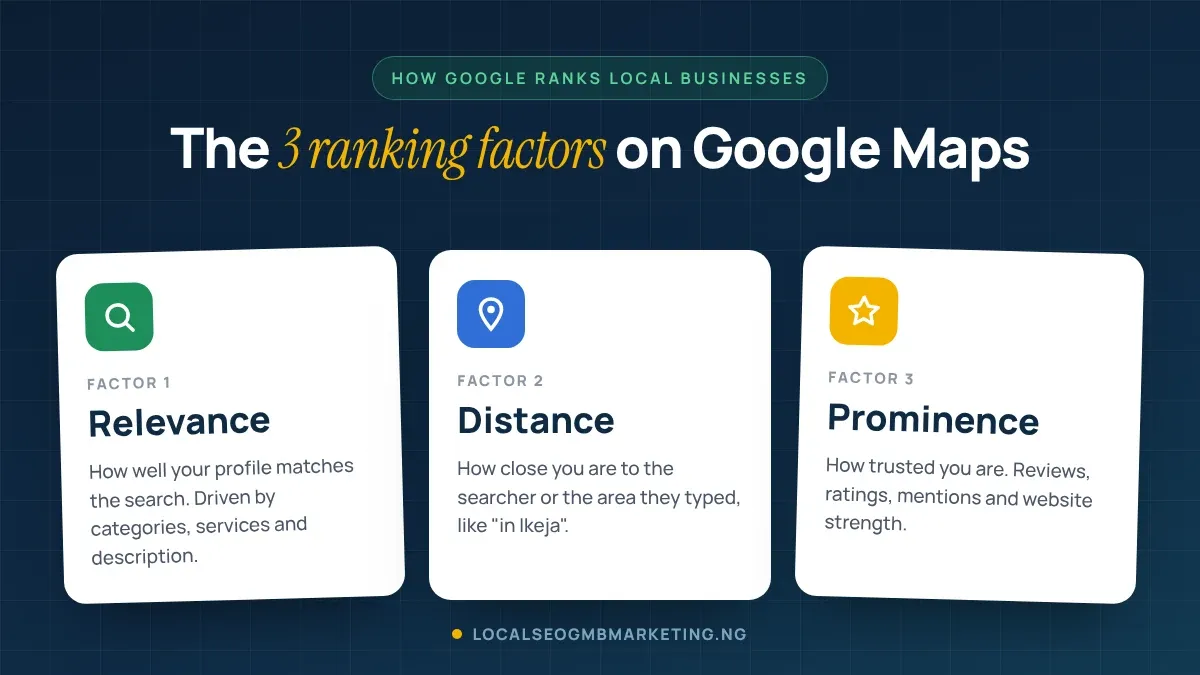
How to Rank #1 on Google Maps in Nigeria:
How to Rank #1 on Google Maps in Nigeria: A Practical Guide for Businesses and Agencies
If your business does not show up in the top three results on Google Maps, you are losing calls, walk-ins and sales to competitors who do. For agencies, helping clients rank on Google Maps has become one of the most requested local SEO services in Nigeria. This guide walks Nigerian businesses and digital marketing agencies through a clear, step by step plan to rank higher on Google Maps in your city.
Why Google Maps Matters for Nigerian Businesses and Agencies
When someone searches “restaurant in Lekki”, “plumber in Abuja” or “digital marketing agency in Lagos”, Google often shows a map with three businesses at the top of the results. This is called the map pack, and those three listings get most of the clicks, calls and direction requests. For restaurants, salons, clinics, law firms, real estate firms, logistics companies and training centres across Nigeria, Google Maps is now one of the main ways new customers find them.
Ranking on Google Maps is not about tricks. It is about giving Google clear, consistent proof that your business is relevant, trusted and active in a specific location. That is what good local SEO does. For agencies, being able to deliver this for clients means results they can see and measure: more calls, more direction requests and more enquiries.
Step 1: Build a Complete Google Business Profile
Your Google Business Profile (formerly Google My Business) is the foundation of your map ranking. Google pulls most of what it shows on Google Maps from this profile, so it must be complete and accurate from day one.
Claim and verify your listing
Go to google.com/business and sign in with a business email, not a personal one if possible.
Search for your business name. If a listing already exists, claim it. If not, create a new profile.
Complete verification. Depending on your business, Google may offer video, phone, email or another method.
Fill every field properly
Business name: Use your real brand name. Avoid stuffing keywords, like “Best Plumber in Lagos Nigeria Ltd”, because it breaks Google’s rules and can get your profile suspended.
Categories: Choose a precise primary category, such as “Dental clinic”, “Marketing agency” or “Logistics service”, then add relevant secondary categories. Your categories have a big effect on which searches you appear for.
Address and service area: Use your full Nigerian address with street, area, city and state. If you visit customers, set a service area that lists only the places you actually serve, such as “Lekki, Victoria Island, Ikoyi”, instead of the whole country.
Phone number: Use a working Nigerian number that customers can reach during business hours.
Website: If you have several branches, link each profile to its own location page on your website. This connects your website and your Google Maps listing.
Write a clear business description
Your description should explain what you do, who you serve and where you operate. Mention your main services and your city naturally, for example “local SEO services in Lagos” or “business consulting in Abuja”, but write for customers first. A clear description also helps Google understand which searches your business matches.
Step 2: Keep Your NAP Consistent and Build Strong Business Listings
NAP stands for name, address and phone number. These details must be the same on your website and every business listing online. In Nigeria, that usually includes local directories, industry platforms and social media profiles that show your contact details. For an audit of your website or GBP visit GBP Audit
Audit and clean up existing listings
Search your business name and phone number on Google to find where your business is already listed, including Nigerian directories, review sites and social networks.
Correct any wrong names, old addresses or outdated phone numbers. Even small differences, like “Rd” on one site and “Road” on another, are worth fixing.
Create new listings on trusted platforms
Beyond your Google Business Profile, list your business consistently on trusted Nigerian and international platforms, such as:
Local directories and business portals for your city or industry
Facebook, Instagram and LinkedIn pages with your correct address
Industry platforms for medical, legal, real estate, education or hospitality businesses
These listings act like references that confirm your business details. Consistent listings help Google trust your location and your brand over time.
Step 3: Use Your Website to Support Your Map Ranking
Your website and your Google Maps ranking are closely connected. Even though the map pack looks separate from the normal search results, Google still looks at your website to judge how relevant and trustworthy your business is. In a competitive area, a strong website can be what moves you into the top three.
Create location pages
Single location: build a detailed contact or location page with your full name, address and phone number, an embedded Google Map, and directions using landmarks people know, like “5 minutes from Shoprite Ikeja”.
Several branches or cities: create a separate page for each one, such as “Digital Marketing Agency in Lagos” and “Digital Marketing Agency in Abuja”, and link each page to its own Google Business Profile.
Optimise your pages for local searches
Include your city or area in your page titles, meta descriptions and main headings, for example “Local SEO Services in Lagos for Growing Businesses”.
Mention your services and locations naturally in your page content and FAQs, the way customers actually search.
Add schema markup (LocalBusiness or Organization) if you or your developer can. It is code that gives Google your business details in a clear, structured format.
Step 4: Reviews and Reputation
In competitive Nigerian markets, reviews are often what separates the businesses in the top three from those further down. Google wants to show businesses that customers trust, and reviews are one of the clearest signs of that trust.
Build a simple review system
After a successful job or purchase, send customers a WhatsApp or SMS message with a direct link to leave a Google review. Many Nigerian customers are happy to support a local business when you make it easy.
Train your staff to ask for reviews at the right moment, such as after a compliment, a referral or a finished project.
For agencies, include a review plan in your local SEO packages. Helping clients get more genuine reviews is one of the clearest ways to show progress.
Reply to every review, good or bad
Thank customers for positive reviews and mention the service or location naturally, for example “We are glad you enjoyed our local SEO training in Lagos.”
Handle negative reviews calmly. Apologise where it is right to, offer to solve the problem by phone or WhatsApp, and never argue in public. Future customers read your replies carefully.
Step 5: Keep Your Google Business Profile Active
Google favours businesses that look open, active and up to date. This matters in Nigeria, where opening hours, addresses and phone numbers sometimes change without anyone updating them online.
Post updates, offers and events
Use the Posts feature to share promotions, new services, webinars and seasonal offers. A Lagos agency, for example, could promote a Google Maps package for restaurants ahead of the festive season, when more people are eating out.
Add clear, real photos of your office, team, work and the signage outside. Photos show customers and Google that your business is real and active.
Keep key information up to date
Update your opening hours for public holidays, Ramadan or fuel scarcity disruptions if your schedule changes. Customers who arrive to find you closed when Google said you were open often leave bad reviews.
Add new services as you grow, such as “local SEO audits”, “digital marketing training for SMEs” or “same day delivery in Lagos”, so you can appear for those searches too.
Step 6: Build Your Reputation Beyond Your Website
Google also looks at what the rest of the internet says about your business. Mentions and links from other trusted websites help your map ranking, especially in busy cities like Lagos, Abuja and Port Harcourt.
Earn local links and mentions
Work with Nigerian blogs, news sites and industry associations to feature your business in articles, case studies or interviews. A logistics company in Port Harcourt, for example, could share insights on supply chains in a local business magazine and get a link back to its website.
Sponsor local events, conferences or community projects where your business is listed on the official website. These local mentions strengthen your connection to your area.
Connect local SEO with your other marketing
Use social media to send people to your location pages and encourage happy customers to leave Google reviews.
Run location-targeted ads on Google or Facebook that promote “Call now” or “Get directions”. Ads do not directly improve your free map ranking, but they can bring more people searching for your brand, which supports your visibility over time.
Step 7: Track Your Results and Keep Improving
Local SEO is not a one-off project. Competition grows and customers search in new ways, so you need to check your results regularly and adjust. Both businesses and agencies need a simple way to measure what is working.
Use your Google Business Profile performance report
Look at which searches people used to find you. Growth in searches for your service, like “salon in Yaba”, rather than only your business name, usually means your local visibility is improving.
Track calls, website visits and direction requests from your profile. These are real business results.
Check rankings from different locations
Map results change based on where the searcher is standing. Someone in Ikeja may see different results from someone in Surulere for the same search. Check your ranking from different areas, either manually or with a local rank tracking tool.
For agencies, send clients a simple monthly report showing ranking changes for their main searches, such as “law firm in Abuja”, alongside the calls and enquiries they received.
Common Google Maps Mistakes Nigerian Businesses Make
Using fake addresses or virtual offices: Google is strict about real addresses. Businesses that use fake locations to appear in more cities often get suspended. Focus on your genuine locations instead.
Stuffing keywords into the business name: Adding “best”, “cheap” or long lists of keywords to your name may work briefly, but it often leads to suspension. Keep your name clean and use keywords in your description, posts and website instead.
Ignoring reviews: Many Nigerian businesses still treat reviews as optional. In reality, reviews are one of the biggest ranking factors you can directly influence, especially in competitive sectors like hospitality, healthcare and professional services.
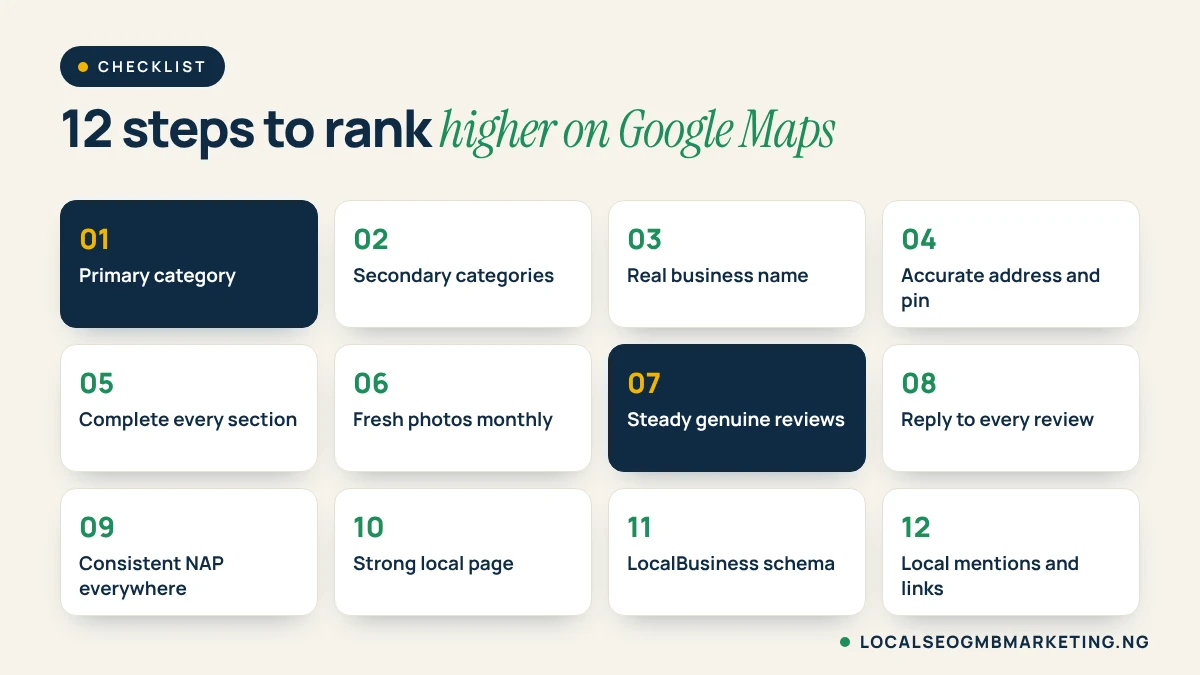
Make Google Maps Work for Your Business
Ranking number 1 on Google Maps in Nigeria is not about gaming the system. It is about building a strong, trusted local presence online and offline. When you combine accurate business listings, consistent contact details, clear location pages, a steady flow of genuine reviews and an active Google Business Profile, you give Google the signals it looks for when choosing the top three.
For Nigerian businesses, this means more calls, more visits and more enquiries without depending only on paid ads. For agencies, Google Maps optimisation is a service clients understand quickly, because they can see their ranking and their calls change in their own performance report.
📌 Key Takeaway: Treat Google Maps as a real sales channel, not just a directory listing. Businesses that apply these local SEO basics consistently will be the ones customers find first.
Next Step: Search for your main service and area on Google Maps today and see where you stand. Fix the basics first: your profile, your contact details and your reviews. Then build on them step by step. With steady effort, reaching the top three in your area is realistic, and the same process works for every location, brand or client you manage.
Frequently Asked Questions About Ranking on Google Maps in Nigeria
Can I pay Google to rank number 1 on Google Maps?
No. You cannot pay for the free map results. Google Ads can show your business as a sponsored result, but that is separate from your organic ranking.
How many reviews do I need to rank on Google Maps?
There is no fixed number. Look at the businesses already in the top three for your main search and aim to match or beat their review count and rating over time.
Why is my business not showing on Google Maps?
Common reasons are an unverified profile, the wrong primary category, an incomplete profile or a suspension. Check your Business Profile for warnings, then work through the steps in this guide.
Can I rank on Google Maps without a physical shop?
Yes, if you visit customers. Set your profile as a service area business and list only the areas you actually serve. You will usually rank best close to your verified base.
Does my website affect my Google Maps ranking?
Yes. A strong website with a clear location page supports your profile and builds trust with Google. A profile linked to a weak or empty page has less to stand on.
How often should I post on my Google Business Profile?
Once a week is a good rhythm for most Nigerian businesses. Share offers, recent work and updates, especially around holidays like Sallah and Christmas.
Why did my business drop on Google Maps?
Common causes are a competitor improving, a change to your category or name, new negative reviews or a profile suspension. Check your profile for warnings first.
Can I rank in Lagos and Abuja with one profile?
One profile ranks best near its verified address. If you have real offices in both cities, create a separate profile for each location, each with its own address and phone number.
Do keywords in reviews help ranking?
When customers naturally mention your service and area, like “best small chops in Lekki”, it helps Google understand what you do. Never tell customers what to write.
Does Google Maps ranking work the same way in the United States?
Yes. The ranking factors are the same everywhere, but competition in cities like Dallas is often higher. See our Dallas service at localseogmbmarketing.com.


